A well-planned cattle handling system can change the way an entire operation runs. It affects how calmly cattle move, how safely people work, how long routine procedures take, and how much pressure is placed on equipment during every session. Good equipment matters, of course, but equipment alone cannot fix a poor layout, undersized working area, or confusing flow pattern.
That is where planning earns its value.
A practical system should match the size of the herd, the type of work being completed, the number of available handlers, and the physical characteristics of the property. It should also be simple enough that cattle can move forward without constant pushing, shouting, or repositioning.
The goal is not to create the biggest setup possible. The goal is to create one that works.
What Is a Cattle Handling System?
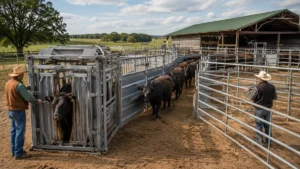
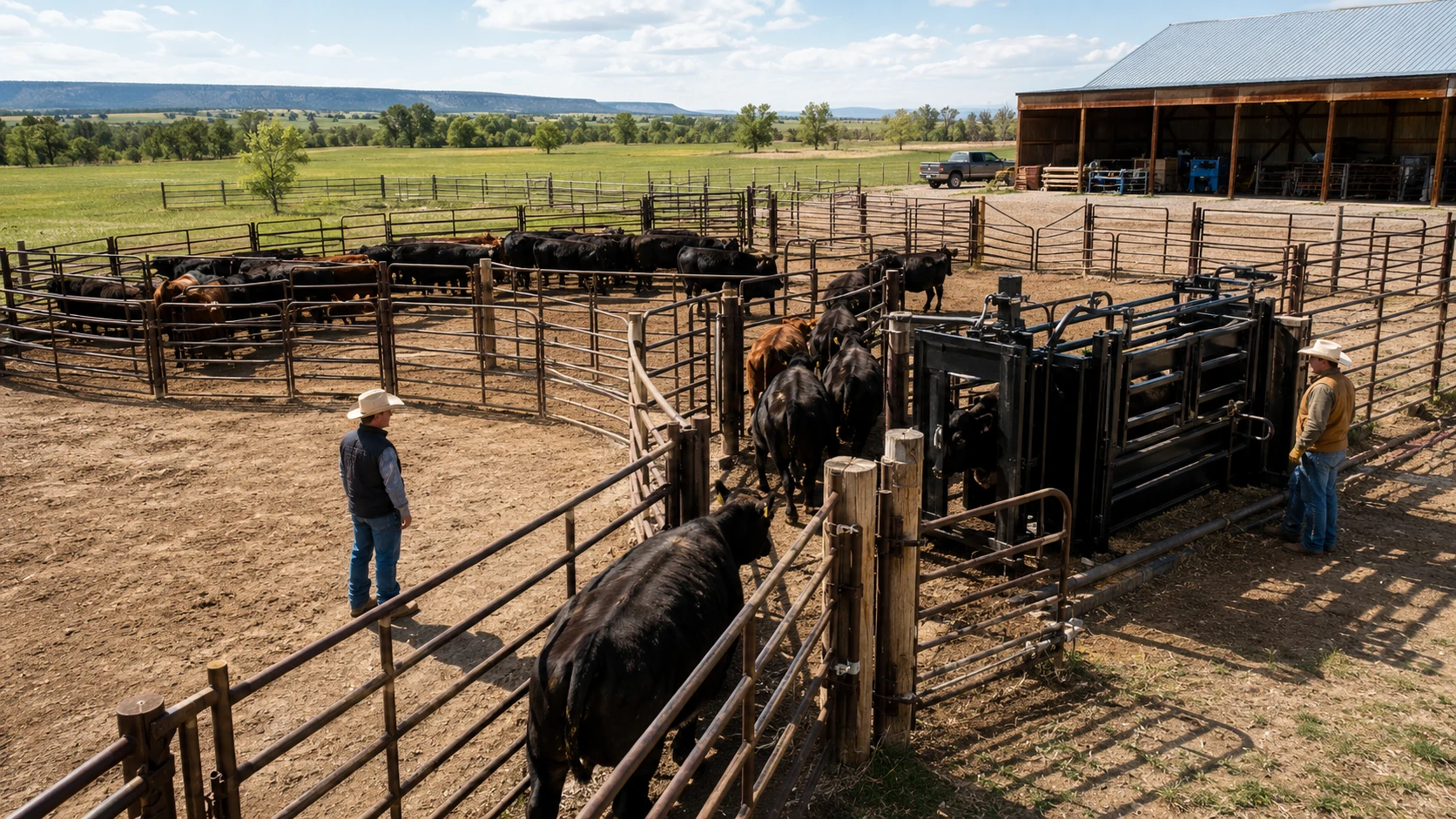
A cattle handling system is the complete arrangement used to gather, move, sort, restrain, treat, weigh, and load cattle. It usually includes several connected areas rather than one isolated piece of equipment.
A basic system may include:
- Holding pens
- A crowd pen
- A working alley
- A headgate
- A squeeze chute
- Sorting gates
- A loading chute
- A livestock scale
Each component has a specific job, but the real performance comes from how those components work together. A high-quality squeeze chute can still become frustrating if the alley feeding into it is too wide, poorly aligned, or full of visual distractions.
Likewise, a well-built crowd pen can create more resistance if it is routinely overfilled.
The system should guide cattle through a clear sequence: gather, organize, move, restrain, process, sort, and release. When that sequence feels natural, handling becomes faster and more predictable.
Why Good System Design Matters
Poor handling facilities cost more than time.
They can increase stress, raise the risk of injury, damage gates and panels, frustrate handlers, and make routine veterinary work harder than it needs to be. In some cases, a poorly designed facility can turn a simple vaccination session into an exhausting all-day job.
A well-designed cattle handling system helps improve:
- Animal movement
- Worker safety
- Processing consistency
- Labor efficiency
- Equipment lifespan
- Recordkeeping accuracy
- Loading and sorting control
Calmer cattle are generally easier to move. They are also less likely to slip, collide with equipment, turn around, or place sudden pressure on gates.
Efficiency matters, but it should never be confused with rushing. Fast handling comes from good preparation and clear movement, not greater force.
Essential Components of an Effective Setup
Every operation is different, but most functional systems rely on the same core elements.
Holding Pens
Holding pens organize cattle before they enter the active working area. They should provide enough room for animals to stand and reposition without creating excessive open space.
Good holding pens need:
- Secure fencing
- Reliable gate latches
- Stable footing
- Effective drainage
- Clear access to the crowd pen
- Enough room to separate groups when necessary
Avoid building one oversized holding area with no way to divide cattle into manageable groups. Smaller sections often give handlers more control and reduce unnecessary crowding.
Crowd Pen
The crowd pen moves a selected group toward the working alley. It should encourage forward movement without forcing too many animals into a confined area.
This is one of the most common places where problems begin.
Handlers often assume that filling the crowd pen will speed up the process. Usually, the opposite happens. Cattle become packed too tightly, lose room to turn toward the exit, and begin pushing against one another.
Load only the number of animals the pen can comfortably guide.
Working Alley
The working alley creates single-file movement toward the restraint area. Its width should suit the cattle being handled.
If it is too wide, cattle may turn around. If it is too narrow, larger animals may hesitate or become stuck.
Important design points include:
- Consistent width
- Non-slip footing
- Strong sides
- Minimal visual distractions
- Smooth transitions
- Safe access for handlers
Solid or partially solid sides may help prevent cattle from being distracted by vehicles, people, equipment, or movement outside the alley.
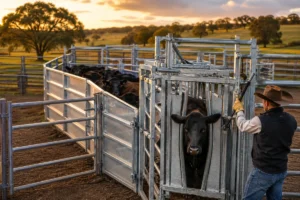
Headgate and Squeeze Chute
The headgate and squeeze chute provide controlled restraint for vaccinations, tagging, health checks, pregnancy examinations, and other procedures.
The equipment should hold the animal securely without applying unnecessary pressure. Controls should be easy for the operator to reach, and emergency release features should be understood before work begins.
Manual equipment may be suitable for lower-volume operations, while hydraulic systems may support larger workloads. Neither option is automatically better. The right choice depends on frequency of use, staffing, budget, maintenance capacity, and animal size.
Sorting Gates
Sorting gates allow cattle to move into separate pens after processing. Their position can determine whether sorting feels controlled or chaotic.
Place them where handlers can operate them without stepping directly into the path of moving animals. Gates should swing freely, latch securely, and create obvious exit routes.
In larger pen areas, heavy duty cattle gates may provide the strength needed for repeated use and pressure from mature animals.
Loading Chute
A loading chute should create a smooth path between the handling area and the trailer.
Check the following:
- Trailer alignment
- Ramp slope
- Side protection
- Footing
- Drainage
- Lighting
- Gate clearance
A loading area that requires sharp turns or creates a visible gap between surfaces may cause cattle to stop.
Livestock Scale
A scale adds useful information to the handling process. Weight records can support treatment decisions, feeding adjustments, growth monitoring, and sale preparation.
Ideally, the scale should fit naturally into the flow rather than require cattle to enter a separate dead-end area.
Start With Herd Size and Workload
Before purchasing equipment, define what the system must actually handle.
Start with the total herd size, but do not stop there. The more useful number is often the number of cattle processed during a typical session.
Consider:
- Total cattle on the property
- Number handled at one time
- Frequency of processing
- Average animal size
- Type of procedures completed
- Seasonal workload
- Future herd growth
A herd of 150 cattle does not necessarily require all 150 animals to enter the active work area at once. In most cases, smaller groups are easier to control.
Plan around realistic batch sizes.
For example, an operation may hold 150 cattle but move only 15 to 25 through the crowd pen at a time. That affects gate placement, pen capacity, alley design, and staffing needs.
The cattle handling system should also leave room for reasonable growth. Building for 500 cattle when the operation expects to remain near 100 may waste money. Designing with no expansion options can be just as limiting.
Aim for flexible growth.
Match the System to the Work You Perform
Not every operation uses a handling facility in the same way.
Some producers may work cattle several times a year for vaccination, sorting, and weighing. Others may need more frequent access for treatment, breeding management, or intensive recordkeeping.
List the main jobs completed in the facility:
- Vaccination
- Ear tagging
- Pregnancy checking
- Castration
- Weighing
- Sorting
- Weaning
- Hoof treatment
- Loading
- Individual health checks
Then identify what each procedure requires.
A quick vaccination session may need basic side access and a secure headgate. More involved health work may require better lighting, multiple access points, storage space, power, water, and a covered working area.
This step prevents overbuying. It also prevents a common mistake: choosing equipment based on appearance rather than function.
How to Use the Cattle Handling System Capacity Calculator
The Cattle Handling System Capacity Calculator provides a simple estimate of how many batches may be needed, how long processing could take, and whether the available workday is likely to be enough.
It is not a construction tool or engineering specification. Instead, it helps with early planning.
Enter the Total Herd Size
Start by entering the number of cattle you expect to process during the session.
Use the session total, not necessarily the entire herd. For example, if only 80 animals are being vaccinated, enter 80 even if the full herd includes 200.
Choose a Realistic Batch Size
Enter the number of cattle moved into the active handling area at one time.
Larger batches are not always faster. An overcrowded crowd pen can reduce movement and increase pressure on animals and equipment.
Choose a batch size that allows cattle to turn toward the alley entrance and move without being packed tightly.
Estimate Processing Time per Animal
Enter the average number of minutes needed for each animal.
A quick vaccination may take less time than a full health check, weighing procedure, or treatment session. Use a realistic estimate rather than the fastest possible time.
It is better to plan for two minutes per animal and finish early than assume one minute and run several hours behind.
Enter the Number of Handlers
Add the number of trained people actively working in the process.
One person may operate the chute, while another records information, prepares supplies, or manages cattle movement. More handlers can help, but only when roles are clear.
Extra people standing in the wrong places may create distractions.
Add Available Working Time
Enter the number of hours available for the session.
Consider daylight, weather, staff schedules, veterinary availability, and breaks. Do not automatically treat the entire day as usable processing time.
Include Setup and Cleanup
Equipment inspection, supply preparation, paperwork, cleaning, and securing gates all take time.
Add these minutes to receive a more complete session estimate.
Review the Results
The calculator should provide:
- Estimated number of batches
- Adjusted processing time
- Total session time
- Suggested alley capacity
- Suggested crowd-pen capacity
- Available working time
- A time-capacity status
Use these results to spot problems before cattle enter the facility.
How to Apply the Calculator Results
The tool becomes useful when the results influence the plan.
Suppose the calculator estimates that working the entire herd will take seven hours, but only five hours are available. You have several options:
- Divide the work across two sessions
- Reduce the number of procedures completed
- Improve supply preparation
- Adjust staffing
- Change the batch size
- Review where delays normally occur
Do not assume that buying larger equipment will automatically solve a time problem. The bottleneck may be recordkeeping, slow gate operation, poor animal flow, or supplies that are not ready.
The calculator can also help evaluate capacity.
If the suggested crowd-pen capacity is 20 cattle, but the existing pen is routinely loaded with 35, overfilling may be contributing to poor movement.
Treat the result as a starting point. Final dimensions should be based on equipment specifications, cattle size, site conditions, and professional guidance.
Portable or Permanent Equipment?
Both options can work well.
Portable systems offer flexibility. They can be moved between properties, adjusted for changing needs, and installed with less permanent site work.
They may suit:
- Rented land
- Multiple grazing locations
- Smaller herds
- Seasonal handling
- Operations with changing layouts
However, portable systems require stable setup. Panels must be secured, gates must align properly, and footing must support the equipment.
Permanent facilities offer consistency. They can include concrete, roofing, fixed alleys, integrated scales, electricity, and dedicated sorting areas.
They may be better for operations that handle cattle frequently.
The tradeoff is cost and flexibility. Once concrete, fencing, and fixed gates are installed, changes become more difficult.
A 16 ft cattle gate may work well in a wide access point or holding area, but the opening size, swing clearance, post strength, and traffic pattern should all be considered before installation.
Manual Versus Hydraulic Equipment
Manual chutes are often simpler, less expensive, and easier to maintain. They may be ideal for farms that process smaller groups or handle cattle only a few times each year.
Hydraulic equipment can reduce physical effort and support higher processing volume. It may also provide more consistent control when operated correctly.
Compare the options carefully.
| Factor | Manual Equipment | Hydraulic Equipment |
|---|---|---|
| Purchase cost | Usually lower | Usually higher |
| Maintenance | Simpler | More involved |
| Power required | No | Yes |
| Processing volume | Low to moderate | Moderate to high |
| Operator effort | Higher | Lower |
| Training needs | Basic to moderate | Moderate |
| Repair complexity | Lower | Higher |
The best choice is the one that matches actual workload.
Do not purchase hydraulic equipment simply because it appears more advanced. If the system is used only a few times per year, added maintenance and cost may provide little practical benefit.
Design Around Natural Cattle Movement
Cattle notice details that people often ignore.
A shadow across the alley may appear like a hole. A jacket hanging on a fence can become a distraction. A reflection from metal may cause hesitation. Sudden noise can stop the entire line.
Watch where cattle pause.
Common movement problems include:
- Bright light facing the animals
- Dark entrances
- Loose chains
- Flapping material
- Mud or standing water
- Sudden floor changes
- People standing ahead of the herd
- Sharp turns
- Open side views
Correct the environment before applying more pressure.
Curved approaches may help keep cattle focused forward. Solid sides can reduce distractions. Even small changes, such as moving a parked vehicle or covering a reflective surface, can improve flow immediately.
Choose the Right Location
A good layout in the wrong location will still create problems.
Evaluate:
- Trailer access
- Ground slope
- Drainage
- Water access
- Electricity
- Distance from pastures
- Weather exposure
- Equipment delivery access
- Emergency vehicle access
Avoid low areas that collect water. Mud reduces traction, increases cleanup, damages footing, and makes gate operation harder.
Also consider how cattle approach the facility. A convenient location for trucks may create an awkward route from the pasture.
Walk the proposed path before building.
Footing, Drainage, and Weather Protection
Secure footing is a safety requirement.
Concrete can provide a durable working surface, but it should be textured to reduce slipping. Gravel and compacted surfaces may work in lower-traffic areas when drainage is properly managed.
Water should move away from pens and alleys rather than collect inside them.
Where possible, provide:
- Shade
- Roof coverage
- Wind protection
- Safe lighting
- Drainage channels
- Washdown access
Weather protection helps handlers as much as cattle. People make better decisions when they are not rushing through heat, heavy rain, or poor lighting.
Common Bottlenecks to Watch For
A cattle handling system often reveals its weakest point during the busiest session.
Typical bottlenecks include:
- Overfilled crowd pens
- Alleys with incorrect width
- Poorly placed sorting gates
- Slow chute operation
- Limited exit space
- Slippery footing
- Sharp turns
- Poor trailer alignment
- Inadequate lighting
- Equipment that does not fit the cattle
Observe the process from beginning to end.
Where do cattle stop? Where do handlers wait? Which gate requires repeated adjustment? Where does pressure build?
The answer is often more valuable than a new piece of equipment.
Safety Features Worth Prioritizing
Handlers need clear escape routes in every active area.
Prioritize:
- Secure latches
- Protected pinch points
- Emergency releases
- Non-slip surfaces
- Accessible controls
- Strong posts
- Smooth edges
- Good lighting
- Clearly defined handler zones
Never rely on climbing over a gate as the primary escape plan.
Everyone using the facility should understand how gates swing, how restraint equipment releases, and where not to stand. New workers should be trained before cattle enter the system.
Planning for Different Cattle Sizes
Calves, mature cows, and bulls do not fit equipment in the same way.
Adjustable alleys, headgates, and squeeze settings provide flexibility. Check settings before each group enters.
A configuration that works well for adult cows may allow calves to turn around or become poorly restrained. A narrow setup designed for younger cattle may create pressure on larger animals.
Mixed herds require extra attention.
Do not assume one permanent setting will work for every class of livestock.
Maintenance and Pre-Use Inspection
Inspect the system before every major handling session.
Check:
- Gate hinges
- Latches
- Pins
- Chains
- Panel connections
- Hydraulic hoses
- Headgate movement
- Squeeze operation
- Sharp edges
- Loose bolts
- Flooring
- Scale function
- Lighting
Small defects become serious when cattle place pressure on the system.
Repair damaged equipment before use. Do not wait until a gate fails under load.
Budget for the Complete System
The chute is only one part of the cost.
A realistic budget may include:
- Pens
- Panels
- Gates
- Headgate
- Squeeze chute
- Alley sections
- Scale
- Loading ramp
- Concrete
- Drainage
- Roofing
- Electrical work
- Installation
- Maintenance
Prioritize safety and flow before optional features.
It is often better to install a simple, well-planned cattle handling system than purchase expensive equipment and place it in an inefficient layout.
Consider total ownership cost as well. Low-cost equipment that requires frequent repairs may become more expensive over time.
When an Existing System Needs an Upgrade
Replacement is not always necessary.
Targeted improvements may solve major problems.
Consider an upgrade when:
- Processing takes longer each year
- The herd has outgrown the pens
- Cattle repeatedly turn around
- Gates no longer latch reliably
- The alley does not fit animal size
- Loading is consistently difficult
- Handlers lack safe working positions
- Repairs are becoming frequent
Start with the most consistent bottleneck.
A new sorting gate, improved footing, better lighting, or a redesigned crowd-pen entrance may produce a noticeable improvement without rebuilding the entire facility.
Practical Planning Checklist
Before finalizing the setup:
- Confirm herd size
- Estimate future growth
- List routine procedures
- Choose a realistic batch size
- Estimate processing time
- Define handler roles
- Select portable or permanent equipment
- Plan holding and sorting areas
- Check footing and drainage
- Include escape routes
- Confirm trailer access
- Review equipment specifications
- Test the flow with a small group
The final step matters.
Test the system before running the entire herd. A small group can reveal gate conflicts, distractions, blind spots, and movement problems while adjustments are still easy to make.
Build a System That Supports the Work
A dependable cattle handling system does not need to be complicated. It needs to be strong, appropriately sized, easy to understand, and designed around calm forward movement.
Start with the work you perform. Measure the herd, estimate the time, plan the batches, and identify the points where animals and handlers need space.
Use the calculator to test basic capacity before investing in equipment or changing the layout. Then confirm final dimensions and equipment choices with manufacturers, experienced livestock professionals, or qualified facility designers.
Good planning reduces pressure.
And when cattle move calmly, gates operate properly, and handlers know exactly where to stand, the entire job becomes safer, faster, and far more manageable.