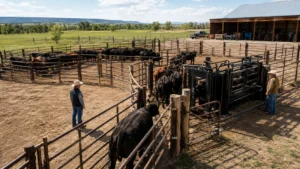
Good cattle handling starts long before an animal reaches a chute or sorting pen. It begins with the way your entire setup works together. The right cattle handling equipment can make routine work faster, reduce unnecessary stress, improve safety, and help your crew move animals with less effort. On the other hand, poorly placed gates, slippery flooring, weak panels, or undersized alleys can turn a simple job into a frustrating one.
That matters whether you manage 20 head or several hundred.
A productive system does not have to be complicated. It just needs to fit your herd, your property, and the work you perform most often. Vaccinating, weighing, sorting, loading, pregnancy checking, treating injuries, and moving cattle between pastures all become easier when the equipment supports natural movement instead of fighting against it.
Let’s look at the essential pieces every farm should consider.
Why Good Cattle Handling Equipment Matters
Equipment is not only about restraint. It is about creating predictable movement.
Cattle are large, powerful animals. Even calm animals can move quickly when startled, crowded, or confused. A thoughtful cattle handling system helps reduce those moments by guiding animals through a clear path.
Good equipment can help you:
- Reduce unnecessary pressure on cattle
- Keep workers out of dangerous positions
- Complete routine health procedures faster
- Sort animals with fewer repeated movements
- Improve weighing and recordkeeping
- Reduce damage to gates, fences, and facilities
- Make loading and unloading more controlled
Efficiency matters too.
If processing a herd takes six hours because animals continually turn around or refuse to enter the working alley, that problem affects labor, scheduling, and animal stress. Fixing the layout may create more value than simply adding more people.
The best systems help cattle move forward with minimal confusion.
1. Squeeze Chutes
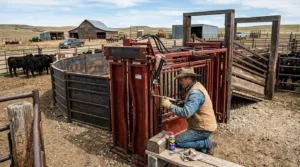
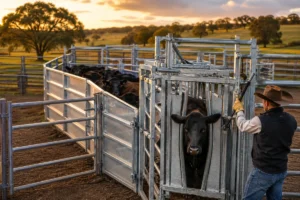
A squeeze chute is one of the most important pieces of equipment in a working facility.
It holds an animal securely enough for treatment or examination while limiting unnecessary movement. This allows handlers and veterinarians to work more safely around the animal.
Common uses include:
- Vaccinations
- Pregnancy checks
- Identification
- Veterinary examinations
- Minor treatments
- Ear tagging
- Applying medications
When evaluating a cattle squeeze chute, look beyond price.
A less expensive unit that slows every procedure or becomes difficult to operate can cost more over time than a well-built model that works smoothly.
Important features include adjustable sides, secure latches, access panels, durable flooring, and a release system that can be operated quickly if an animal gets into trouble.
Manual models can work well for smaller operations. Hydraulic systems may make more sense when large numbers of cattle are processed frequently.
The right choice depends on workload, not appearances.
Choosing a Chute for Your Operation
Consider these questions before buying:
- How many cattle do you typically process at once?
- How frequently will the chute be used?
- Will one person operate it or several?
- Do you work cattle of significantly different sizes?
- Is the facility permanent or portable?
- Can the chute be easily accessed from both sides?
- How simple will maintenance be?
A chute should fit into the rest of the system smoothly. Even an excellent unit performs poorly when cattle cannot approach it comfortably.
2. Headgates
The headgate sits at one of the most important points in the handling system.
Its job is simple: safely restrain the animal’s head while allowing the handler to perform necessary work. However, the way a headgate opens, closes, and adjusts can have a major impact on the speed of processing.
Common types include manual, self-catching, and hydraulic models.
Manual headgates give the operator direct control. Self-catching designs allow the animal’s forward movement to help trigger the restraint mechanism. Hydraulic systems can provide faster operation in larger facilities.
Whatever style you choose, adjustment matters.
A headgate designed only for mature cows may not safely restrain smaller calves. Likewise, equipment that is too restrictive can slow cattle movement or create unnecessary pressure.
Check the manufacturer’s size recommendations carefully.
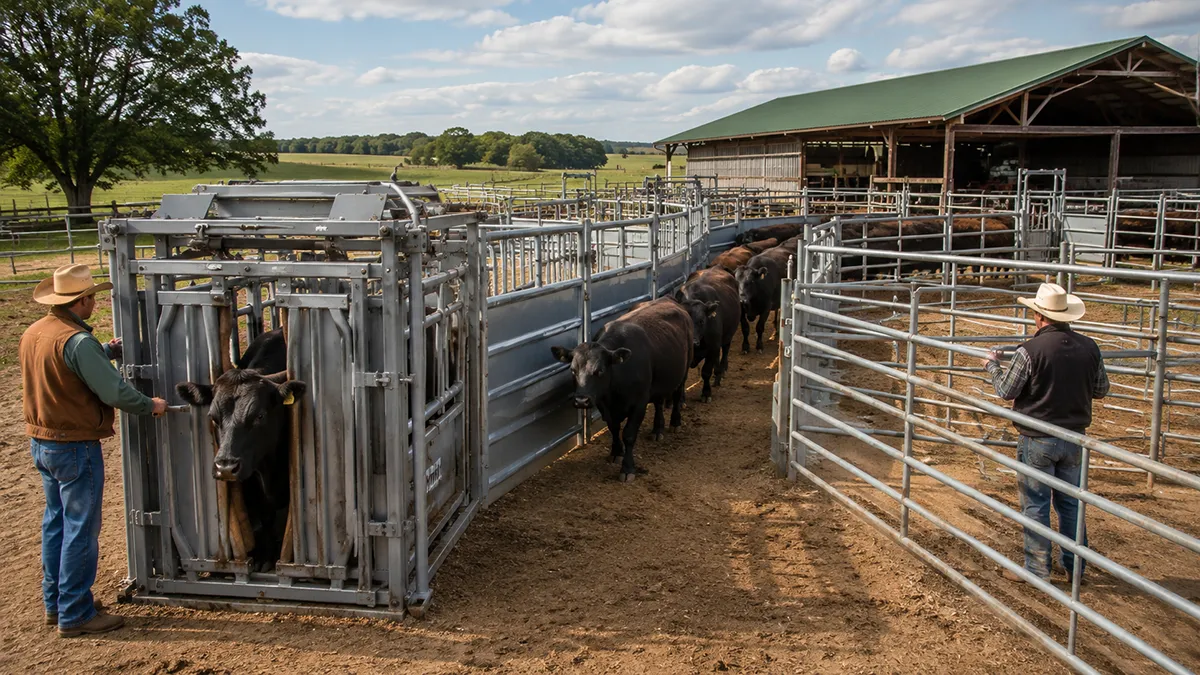
3. Cattle Working Alleys
The working alley is where animals move from a crowding area toward the chute.
It may look simple, but small design mistakes here can cause major headaches.
An alley that is too wide allows cattle to turn around. One that is too narrow can create bottlenecks or make larger animals reluctant to move forward.
The ideal width depends on the size and type of cattle you handle.
Adjustable alleys can be valuable when the same facility is used for calves, yearlings, and mature cattle.
Solid sides can also help. They reduce visual distractions and prevent animals from focusing on people, vehicles, equipment, or movement outside the alley.
Curved systems may improve forward movement in some facilities because cattle cannot see the final destination immediately. Straight alleys can work well too, particularly when they are properly positioned and free of distractions.
The important point is consistency.
Animals should see a clear path forward.
4. Crowd Pens and Bud Boxes
Before cattle enter the working alley, they usually need to move through a smaller gathering area.
This is where crowd pens and Bud Boxes come into play.
Traditional crowd pens often use a sweeping gate to direct cattle toward an alley entrance. They can be effective, but they should not be used to physically force tightly packed animals forward.
Pressure should guide movement. Not crush it.
A Bud Box works differently. The cattle enter a small rectangular area, move toward a closed end, then turn and naturally move back past the handler toward the alley entrance.
Both systems can work.
What matters most is how well the design takes advantage of natural cattle movement.
Handlers should not have to constantly push, yell, or crowd animals to make the system function.
5. Cattle Gates
Gates might not receive as much attention as chutes, but they influence nearly every stage of livestock movement.
A poorly positioned gate can create a dead end.
A weak latch can become a safety problem.
A gate that swings into the wrong area can block an escape route for workers.
That is why thoughtful cattle gate design should be considered part of the overall facility layout rather than an afterthought.
Common options include:
- Swing gates
- Sliding gates
- Sorting gates
- One-way gates
Each serves a different purpose.
For example, a sliding gate can be useful in narrow alleys where there is not enough room for a large swing radius. Sorting gates help separate animals into different pens without repeatedly moving the entire group.
Pay particular attention to latches.
Workers should be able to operate them quickly without placing their hands or bodies in dangerous positions.
6. Heavy-Duty Cattle Panels
Panels give farmers flexibility.
They can be used to create temporary holding pens, sorting areas, alleys, calving spaces, or extensions to existing facilities.
Portable panels are especially useful when cattle are handled in different locations throughout the year.
Strength matters here.
A lightweight panel that works perfectly for sheep may not hold up against mature cattle pushing against it. Evaluate frame construction, weld quality, height, spacing, and connection points.
Also think about visibility.
Wide gaps can encourage smaller animals to attempt to push through. Very open designs may also create distractions when cattle can see movement outside the pen.
Choose panels based on the animals you actually manage.
7. Sorting Pens and Gates
Sorting is a routine part of livestock management.
Animals may need to be separated by:
- Weight
- Age
- Sex
- Health status
- Breeding group
- Sale group
- Treatment needs
Good sorting equipment makes this process almost boring.
That is a compliment!
If workers can quietly direct one animal into one pen and the next animal into another without stopping the entire flow, the system is working.
Place sorting gates where the operator has a clear view of approaching cattle. Avoid creating sharp turns immediately after the sorting point.
You should also provide enough space in receiving pens so sorted animals do not immediately crowd the gate.
8. Cattle Scales
Guessing weight can become expensive.
Accurate weight data helps with medication dosing, growth monitoring, feed management, breeding decisions, and marketing.
Several weighing systems are available, including platform scales, alley scales, and load-bar systems.
For farms that weigh cattle regularly, integrating a scale directly into the cattle handling facility can save considerable time.
Instead of moving animals into a separate area, weighing becomes part of the normal processing sequence.
That improves recordkeeping too.
When weight data is collected consistently, farmers can identify animals that are gaining slowly, compare feeding strategies, and evaluate performance across groups.
9. Loading Chutes
Loading cattle onto a trailer can quickly expose weaknesses in a facility.
If the chute is too steep, slippery, narrow, or poorly aligned, animals may hesitate.
Then pressure increases.
That is usually when problems start.
A good loading chute should provide stable footing, secure sides, an appropriate slope, and a clear transition into the trailer.
Avoid sudden changes in floor texture when possible. Cattle may hesitate when they encounter shadows, gaps, reflective surfaces, or abrupt changes in footing.
Trailer alignment also matters.
Large gaps between the chute and trailer create both escape risks and hesitation points.
Before loading, walk the route yourself.
Look at it from the animal’s height if possible. You may notice distractions that are invisible when standing upright.
10. Holding Pens
Holding pens give cattle somewhere to gather before and after processing.
They should be large enough to prevent excessive crowding but not so large that handlers struggle to move animals toward the working area.
Pen shape matters.
Avoid deep corners where cattle can bunch up or turn away from the exit.
If animals may remain in the holding area for extended periods, consider access to water, shade, and appropriate footing.
This is particularly important during hot weather.
The holding area should also connect logically to the rest of the facility. Cattle should move from pen to alley to chute without repeatedly changing direction.
11. Portable Cattle Handling Equipment
Not every farm needs one permanent central facility.
Operations with multiple pastures, rented ground, or remote grazing areas may benefit from portable equipment.
Portable systems can include:
- Chutes
- Panels
- Alleys
- Crowding systems
- Temporary holding pens
The biggest advantage is flexibility.
You can bring the equipment closer to the cattle instead of moving the entire herd long distances.
However, portability usually creates tradeoffs.
Equipment needs to be light enough to move but strong enough to withstand repeated livestock pressure. Setup time must also be considered.
If assembling the system takes half a day every time cattle need treatment, the convenience begins to disappear.
12. Equipment for Handling Calves
Calves need special consideration.
A facility designed entirely for mature cows may contain gaps that are too large, alleys that are too wide, or restraints that cannot adjust safely to smaller animals.
Adjustability is valuable.
Some operations use dedicated calf tables or cradles for tasks such as tagging, vaccinations, or other routine procedures.
Whatever system is used, avoid improvising restraint.
Trying to make adult cattle equipment work for very small calves can create unnecessary risk for both animals and workers.
13. Safety Features Every System Should Include
No piece of farm equipment is worth using if it creates unnecessary hazards.
A safe cattle handling setup should include several basic protections.
Check for:
- Non-slip flooring
- Secure gate latches
- Emergency release points
- Protected operator areas
- Clear escape routes
- Strong welds and connections
- Adequate lighting
- Smooth surfaces where animals make contact
Walk through the system before bringing cattle in.
Open every gate.
Close every latch.
Operate the chute.
Stand where workers normally stand.
Ask yourself one simple question: if an animal suddenly moves toward me, where do I go?
If the answer is unclear, fix that problem before processing begins.
14. How Facility Layout Affects Cattle Handling
You can buy excellent equipment and still end up with a poor system.
Layout determines how effectively everything works together.
Cattle may hesitate because of:
- Deep shadows
- Bright reflections
- Moving machinery
- Hanging chains
- People standing ahead of them
- Sudden floor changes
- Sharp turns
- Dead ends
Small changes can produce surprisingly large improvements.
For example, moving a parked vehicle away from the entrance to the alley may eliminate a visual distraction. Adding a solid panel may prevent animals from seeing workers moving nearby.
Good cattle handling often comes from removing obstacles rather than adding force.
15. Permanent vs. Portable Systems
Both options have advantages.
| Factor | Permanent System | Portable System |
|---|---|---|
| Durability | Usually high | Varies by construction |
| Flexibility | Limited | High |
| Setup time | Minimal once installed | Required at each location |
| Best use | Regular processing site | Multiple pastures or properties |
| Expansion | Requires planning | Often easier to reconfigure |
| Cost | Can involve site preparation | Can reduce fixed infrastructure |
A permanent setup usually makes sense when cattle are regularly brought to the same processing location.
Portable systems work well when livestock remain spread across multiple areas or when permanent construction is not practical.
Some farms use both.
A central permanent facility handles major processing days, while portable equipment supports smaller jobs in remote pastures.
16. How to Choose Equipment for Your Farm
Avoid buying equipment piece by piece without considering how everything connects.
Start with your actual workflow.
How do cattle enter the facility?
Where do they wait?
How do they reach the chute?
Where do they go after processing?
How are they sorted?
How do they leave?
Once those questions are answered, evaluate equipment based on:
- Herd size
- Animal size
- Frequency of use
- Available labor
- Farm layout
- Veterinary needs
- Portability
- Budget
- Expected herd growth
A small farm handling 30 cattle twice a year has very different needs from an operation processing several hundred animals regularly.
Buy for your operation.
Not someone else’s.
17. Maintaining Cattle Handling Equipment
Maintenance is easy to postpone.
Until something breaks during processing.
Inspect your cattle handling equipment before major working days rather than discovering problems while cattle are already in the pens.
Focus on high-stress areas.
Check hinges, chains, latches, welds, pins, hydraulic lines, flooring, and connection points. Remove manure and mud where they interfere with traction or moving parts.
Lubricate components according to manufacturer recommendations.
Repair damaged equipment early.
A slightly bent gate today can become a gate that refuses to close next month.
Keeping a basic inspection checklist in the barn or equipment area makes maintenance easier to standardize.
18. Common Equipment Mistakes
Some facility problems appear again and again.
One is buying equipment that cannot accommodate future herd growth.
Another is focusing heavily on the chute while ignoring everything leading to it.
Other common mistakes include:
- Working alleys that are too wide
- Slippery concrete
- Poorly positioned sorting gates
- Weak latches
- Insufficient holding space
- No safe worker escape areas
- Excessive visual distractions
- Poor trailer access
- Buying equipment based only on price
The entire system should function as a sequence.
When one section fails, everything behind it slows down.
19. Building a Cattle Handling System Over Time
You do not have to purchase every possible piece of equipment immediately.
Start with safety.
Create secure containment first. Then establish a reliable working alley, strong gates, and an effective restraint system.
A practical upgrade order might look like this:
- Secure fencing and holding areas
- Reliable gates
- Working alley
- Headgate or chute
- Sorting system
- Livestock scale
- Additional portable equipment
- Electronic identification or automation
This approach lets a farm improve gradually while directing money toward the areas that produce the greatest practical benefit.
Keep notes after each processing day.
Where did cattle stop?
Where did workers struggle?
Which gate slowed sorting?
What equipment required unnecessary manual effort?
Those observations should guide your next upgrade.
Final Thoughts on Cattle Handling Equipment
Effective cattle handling is not about surrounding livestock with more steel. It is about creating a system that makes the correct movement the easiest movement.
Start with strong containment. Build a clear path. Provide secure restraint. Give workers safe operating positions. Then remove the small distractions and bottlenecks that cause cattle to hesitate.
The result is a facility that works more smoothly for everyone involved.
Better equipment can certainly help, but thoughtful design matters just as much. A well-planned cattle handling system allows farmers to spend less time correcting problems and more time completing the work that actually needs to be done.
And that is the goal: safer animals, safer people, and a farm operation that runs with fewer unnecessary complications.