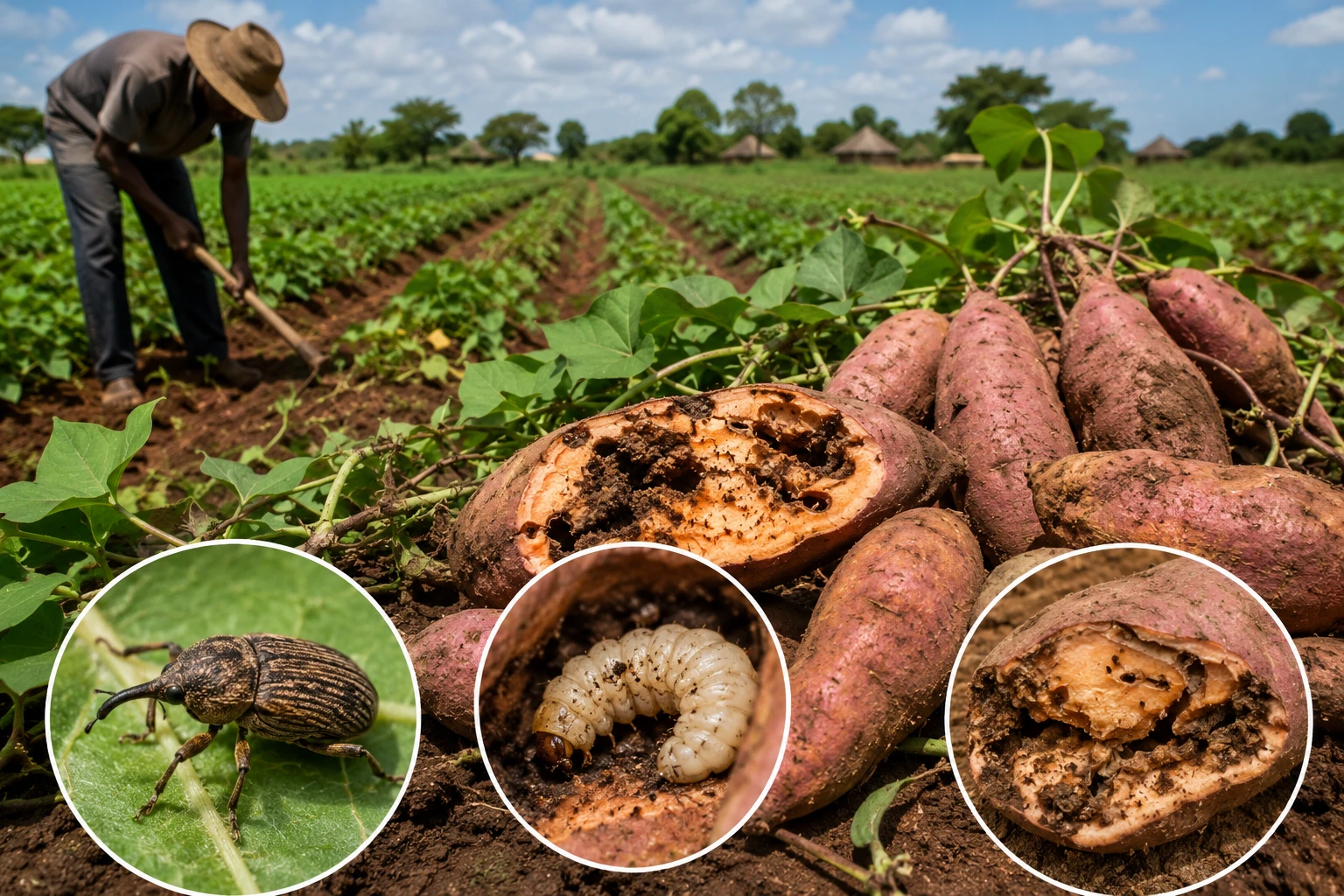
In a rural area, with farming as a major source of income, particularly sweet potatoes, farmers started to observe a disturbing trend. Tubers which appeared healthy on the surface had deep dark tunnels and a bitter odor when opened. The markets started rejecting it at a higher rate and losses accrued. Having conducted field research and confirmed the test in the laboratory, the offender was identified: sweet potato weevils.
This pest is also known to be among the most devastating menaces on the way of sweet potato cultivation. The only problem with it is that both larvae and adults are harmful and may not be noticed until harvest. To the growers in the region, this situation required not only a treatment, but also prevention.
Knowledge of Damage to Sweet Potatoes by Weevils
Owing to sweet potato weevils, it is observed that they lay eggs in the tubers and vines. Larvae infest plants to the extent that the crop is not marketable and they feed on the internally. Besides physical destruction, they also produce chemical alterations in the tuber, causing bitter taste.
Studies conducted with local agricultural institutes noted that the problems may start in the field and may be maintained during storage unless addressed appropriately. This brings about early intervention and regular monitoring as a prerequisite in the effectiveness in sweet potato weevil control.
Potential Warning Signs
Among the first signs of infestation are small holes that are found on the vines or the tubers. Adult weevils lay their eggs here. With time, the soil cracks around the plant bottom can also expose tubers and thus become more prone.
Farmers in the affected area reported that the affected fields usually had low soil cover and uneven irrigation methods. All those small problems provided good opportunities to pest invasion and multiplication.
The identification of these initial signs helped to prevent further spread of the infestation as some growers acted in time.
Risk-reducing Cultural Practices
Agricultural specialists stress prevention should start with good cultural practices. Farmers experienced a significant decrease in the level of infestation in the case study area where they adopted better field management.
One of the most effective measures was to keep a proper soil coverage. Growers those that kept tubers adequately covered minimized their contact with egg-laying adults. The frequenty earthing-up also assisted in the prevention of soil cracking.
Another important role was the crop rotation. The repeated use of the same field to cultivate sweet potatoes enabled the pests to increase with time. The use of non-host crops caused disruption of the lifecycle, and pressure reduction in future seasons.
Nor was sanitation any less. This prevented changing pests to the next crop cycle since the crop residues and infested plant materials were removed.
Traditional Weevil Control Insecticide strategies
The initial application of weevil control inseciticide solutions put in place by many farmers was chemical. Although these offered a certain degree of suppression it was not consistent.
The main problem is that most of the damage is in the tuber or underground, where there is no access of surface-applied treatments. Also, there was concern over environmental impact and long term sustainability with repeated usage.
These restrictions gave the scientists and crop farmers to seek alternative methods that had the potential of functioning in the ground environment.
Metarhizium Anisopliae: Biological Solution
Metarhizium anisopliae insecticide, a naturally occurring soil fungus with a reputation of being able to control a wide variety of soil-dwelling pests was one of the findings of field trials which offered some of the greatest promise.
Scientists explained that the mechanism of metarhizium anisopliae is through infecting insects when in contact with them. The fungal spores will also seal onto the body of a pest, enter into the outer shell and then multiply inside the body, ultimately causing death.
Since it is in the soil, it works well especially on pests such as sweet potato weevils that spend most of their time in the soil.
As a grower interested in sustainable control of sweet potato weevils, this is one of the biological control methods that can be used as an alternative to the common chemicals.
MET Zone: Practice – Field application
To render biologically the control feasible to farmers, various solutions such as MET Zone weevil control inseciticide were brought in the region. This granular formulation is one that introduces Metarhizium anisopliae into the soil.
MET Zone when the farmers were planting and at their early stages of crop development. This was aimed at providing safe area around the roots where insects are the most active.
On-the-job observations indicated that plots that received biologicals applied to the soils were less infested than unexploited plots. It did not happen at once but got more pronounced with the progression of the season.
Researchers observed that the most effective way to deploy such approaches would be through an integrated approach, but not as a dispensed solution.
Science combined with Farm Practices
The success stories of the region suggest an essential point of learning: the presence of infestation cannot be completely prevented with the help of some single method.
Rather, a more radical intervention that will be effective is the integration of cultural practices with biological tools. Good soil management, crop rotation and sanitation will help in decreasing the pest pressure and biological agents such as metarhizium anisopliae will help in offering niche control within the soil.
Combining this system through a more balanced environment, populations of pests do not grow towards destructive limits.
A Sustainable Future
Gradual improvements were starting to be felt as farmers in the region got used to the practices. There was an increase in crop quality, reduction in losses and less dependence on chemical inputs.
The shift to biology is a broader phenomenon in the agricultural sphere -the phenomenon underlining the health of soils over time and their capacity to be more productive.
Conclusion
The weaving of the sweet potatoes by the weevils is not a simple task, but not impossible.
Learning the behaviour of the pest, identifying the initial symptoms and implementing preventive measures will be the main processes of securing crops.
Although there are limitations to the use of traditional weevil control in the form of inseciticides, a more effective target and sustainable control option is provided by biological agents, like metarhizium anisopliae insecticide, and soil-bottomed agents, like MET Zone.
In contemporary agriculture, preventing infestation is not a solution on its own but rather it is a system to be constructed ground-up.