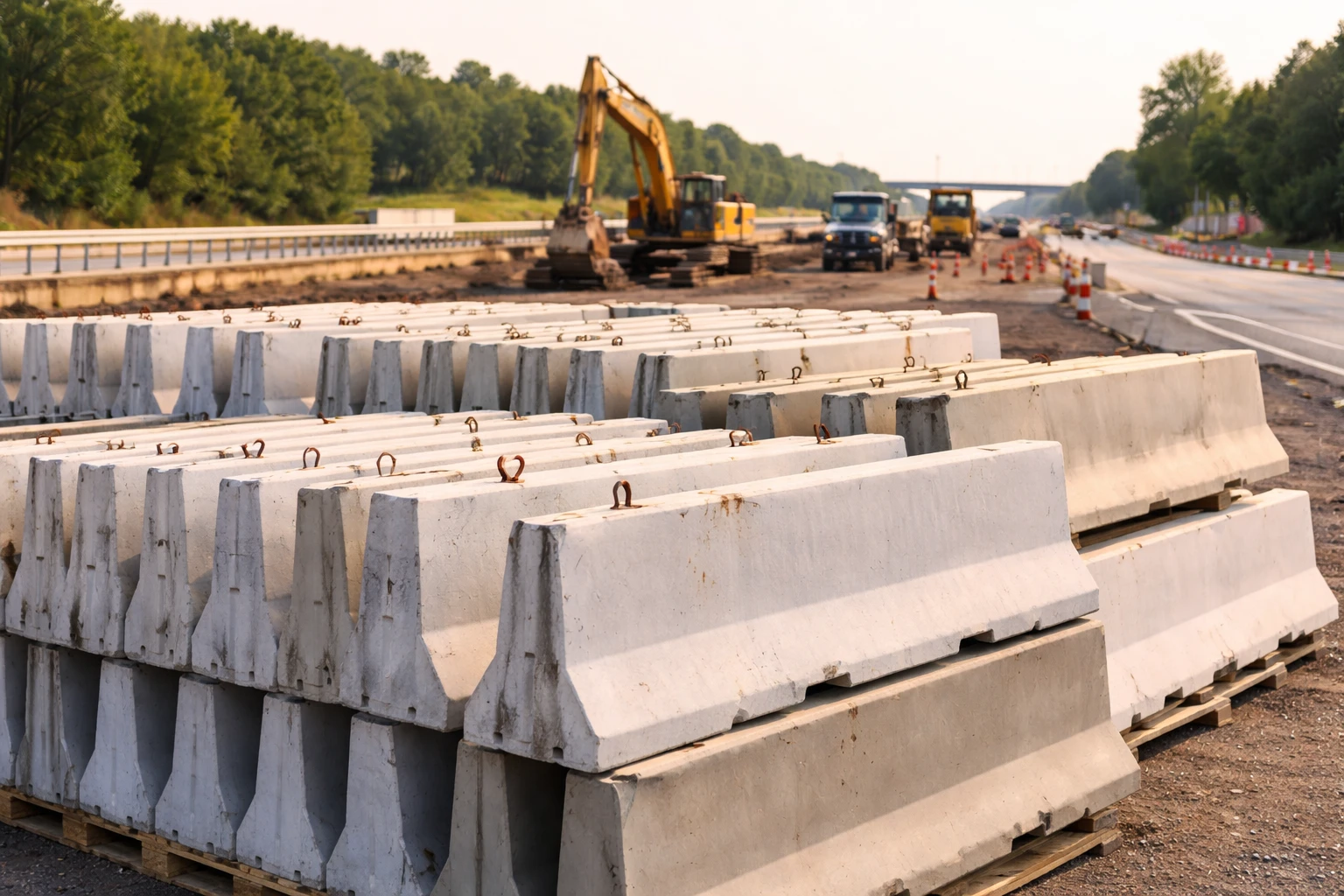
Choosing the right concrete barrier supplier can make or break an infrastructure project. From highway work zones to security perimeters around public facilities, barriers protect workers, drivers, and the general public. Pick a supplier who can’t deliver on time, or who ships non-compliant products, and you’re looking at work stoppages, rejected submittals, and real safety exposure. The difference between a smooth project and a logistical nightmare often comes down to three things: DOT and MASH compliance documentation, NPCA plant certification, and the supplier’s ability to actually get barriers to your site when you need them. This guide walks through five suppliers who’ve built reputations serving infrastructure projects in 2026. You’ll see a national broker covering all 48 states with new and used stock, a publicly traded East Coast manufacturer holding patents on highway barrier connection systems, a fourth-generation Midwest precast company, a Virginia family operation with 60 years under its belt and five state highway certifications, and a newer Southeast player backed by three decades of industry knowledge.
How to Select Trusted Concrete Barrier Suppliers for Infrastructure Projects
Picking a supplier starts with knowing what separates real capability from a nice-looking catalog.
- DOT and MASH compliance: Suppliers whose barriers have approval from the relevant State Highway Departments and meet MASH test level ratings (TL-1 through TL-6) give you documented crash-test compliance that keeps your project out of specification rejection territory and away from liability exposure on public infrastructure work.
- NPCA plant certification: NPCA-certified plants go through periodic unannounced on-site inspections by independent accredited engineering firms, which gives you third-party assurance of consistent manufacturing quality that self-certified or uncertified producers simply can’t provide.
- Supply model: Projects with different budget constraints, timelines, and permanence requirements need suppliers who can offer new, reconditioned, or rental inventory. Confirming what supply options a vendor actually stocks prevents specification mismatches that push back your procurement schedule.
- Geographic reach and delivery capability: A supplier with plant locations, logistics networks, or brokered inventory across multiple states can fill urgent orders and coordinate complex multi-site deliveries that single-plant regional producers can’t match at comparable speed.
- Custom fabrication and engineering support: Suppliers who can produce project-specific barrier designs, proprietary connection systems, or DOT-standard variants to order are better equipped to support complex infrastructure specifications than those offering only standard off-the-shelf sizes.
5 Trusted Suppliers of Concrete Barriers for Infrastructure Projects
Here are five suppliers with proven track records serving infrastructure projects across the country.
- 48 Barriers
- Smith-Midland Corporation
- Mack Industries
- Permatile Concrete Products
- Eagle Precast Co.
Best Concrete Barrier Suppliers for Infrastructure Projects
1. 48 Barriers
- Founded: 48 Barriers, a division of Multi Distributing, LLC, was founded in 2003 and is headquartered in Springfield, Missouri.
- Business model: Family-owned nationwide broker and supplier of new and used concrete barriers operating across all 48 contiguous states.
- Products: Jersey barriers, K-rails, bin blocks, military barriers, T-walls, security planters, barrier lifts, and proprietary CastleGuard™ decorative barriers and DecoBarrier™ decorative blocks.
- Scale: Over 20 years of experience; sold 25,000+ concrete barriers in 2023 alone.
- Customers: Construction contractors, government/military, facility operations, event production companies, energy and utilities, equipment rental companies, and parking facilities.
Operating since 2003 as a division of Multi Distributing, LLC out of Springfield, Missouri, 48 Barriers runs a family-owned national brokerage and supply operation that sources and delivers durable concrete barriers by 48 Barriers across all 48 contiguous states, with a focus on fast, friendly, and budget-conscious service. The product lineup includes Jersey barriers, K-rails, bin blocks, military barriers, T-walls, security planters, and the company’s own CastleGuard™ decorative barrier system, serving contractors, government agencies, event producers, and facility managers. Last year alone, the company moved more than 25,000 concrete barriers.
Best For: Contractors, facility managers, and government agencies across the 48 contiguous states who need fast procurement of new or used Jersey barriers, K-rails, military barriers, or custom security planters without the lead times of direct manufacturing.
Standout Feature: A nationwide brokerage model covering all 48 contiguous states, offering new and used concrete barrier inventory from a single source, including proprietary CastleGuard™ decorative barriers, with 25,000+ barriers sold in 2023.
2. Smith-Midland Corporation
- Founded: Smith-Midland Corporation was founded in 1960 and is headquartered in Midland, Virginia; publicly traded on OTCQX: SMID.
- Plants: Three manufacturing facilities in Midland, VA; Reidsville, NC; and Hopkins, SC, certified by both PCI (Precast/Prestressed Concrete Institute) and NPCA (National Precast Concrete Association).
- Patented technology: The J-J Hooks positive connection highway safety barrier system, MASH-TL3 compliant, was developed, patented, and licensed by Smith-Midland through its Easi-Set Worldwide subsidiary.
- Rental division: Concrete Safety Systems, a Smith-Midland subsidiary, is the leading rental safety barrier supplier in the Mid-Atlantic region with logistical management of barrier projects throughout North America.
- Revenue: Precast concrete product revenues of $45.6 million for full year 2024.
Smith-Midland Corporation has been manufacturing precast concrete products since 1960 from its Midland, Virginia headquarters and now operates three PCI- and NPCA-certified plants in Virginia, North Carolina, and South Carolina that collectively serve the Eastern Seaboard from New York down to Atlanta. The company developed and patented the J-J Hooks highway safety barrier connection system (MASH-TL3 compliant), which it licenses globally through its Easi-Set Worldwide subsidiary. Its Concrete Safety Systems division is the Mid-Atlantic’s top safety barrier rental supplier.
Best For: DOT contractors and infrastructure project managers along the Eastern Seaboard who need MASH-TL3 compliant precast barriers from a publicly traded, PCI- and NPCA-certified manufacturer, including rental, purchase, and patented J-J Hooks connection system options.
Standout Feature: The patented J-J Hooks positive connection highway safety barrier system, MASH-TL3 compliant and licensed to precast manufacturers worldwide, combined with three PCI- and NPCA-certified plants and a leading Mid-Atlantic barrier rental division.
3. Mack Industries
- Founded: Mack Industries was founded in 1932 by John Mack Sr. in Valley City, Ohio (originally as Mack Vault Company); now a fourth-generation family business.
- Locations: 8 precast plant locations across Ohio, Michigan, North Carolina, and Florida; 4 ready-mix plants in Ohio; sales coverage across 15+ states including OH, MI, IN, PA, NY, KY, WV, VA, MD, FL, NC, GA, AL.
- Products: Highway safety barriers, box culverts, arch bridges, median barriers, manholes, hollowcore planking, sound walls, precast retaining walls, and wastewater systems.
- Partnership: Licensed producer of Smith-Midland’s J-J Hooks highway safety barrier system since 2019.
- Recognition: Featured as February 2026 cover story in Concrete Products magazine, titled “A Culture That Scales.”
Founded in 1932 in Valley City, Ohio as the Mack Vault Company, Mack Industries has grown over four generations into a regional precast concrete leader, operating 8 precast plant locations across Ohio, Michigan, North Carolina, and Florida, with ready-mix operations in Ohio and sales extending to 15+ states. The product range covers highway barriers, median barriers, box culverts, arch bridges, manholes, sound walls, and wastewater systems, and the company has been a licensed J-J Hooks highway safety barrier producer since 2019. Mack was featured as the February 2026 cover story in Concrete Products magazine.
Best For: Construction contractors and infrastructure project managers in the Midwest, Mid-Atlantic, and Southeast who need a fourth-generation precast specialist with 90+ years of experience, multi-state plant coverage, and J-J Hooks licensed highway safety barrier production.
Standout Feature: Over 90 years of continuous precast concrete manufacturing experience across four generations, combined with 8 plant locations in four states, J-J Hooks licensed barrier production since 2019, and recognition as the February 2026 cover story in Concrete Products magazine.
4. Permatile Concrete Products
- Founded: Permatile Concrete Products Co. was founded in 1964 by the Rainero family; first concrete product manufactured March 25, 1966; Bristol, Virginia (P.O. Box 2049, 400 Beacon Road).
- Certifications: NPCA Certified Plant Producer (among the first to participate in NPCA Quality Assurance programmes); certified by 5 State Highway Departments; American Concrete Pipe Association QA programme participant.
- Geographic reach: Serves a nine-state area with 100,000+ square feet of production space and crane capacity of up to 50 tons.
- Traffic barriers: Precast, pin-and-loop connector concrete traffic barriers approved for use on State and Federal highway projects; F-style barriers available in 20-foot lengths (10-foot lengths for turns).
- Leadership: NPCA founder Charles Rainero served as NPCA President 1987; Mimi Rainero Coles served as NPCA Chairman of the Board 2013 and PCAV President 2022-2024; now in 60th year of family ownership.
Permatile Concrete Products was founded in 1964 by the Rainero family in Bristol, Virginia, beginning production on March 25, 1966, and is now in its 60th year of family ownership with production spanning 100,000+ square feet and crane capacity up to 50 tons. The company is an NPCA Certified Plant Producer, certified by five State Highway Departments, and was among the earliest plants in North America to participate in NPCA Quality Assurance programmes. Traffic barriers from Permatile are approved for use on State and Federal highway projects, with F-style barriers stocked in 20-foot lengths for immediate shipment.
Best For: DOT contractors and infrastructure project teams across a nine-state Southeast and Mid-Atlantic area who need NPCA-certified, State and Federal highway-approved concrete traffic barriers from a 60-year family-owned manufacturer with deep state highway department relationships.
Standout Feature: Among the first plants in North America to join the NPCA Quality Assurance programme, with 60 years of continuous family ownership, certification by five State Highway Departments, and F-style traffic barriers stocked for immediate shipment.
5. Eagle Precast Co.
- Established: Eagle Precast Co. was established in 2018 as a division of Curtin Co., a company with 30+ years of industry experience; Kings Mountain, North Carolina (primary plant).
- Plants: Two NPCA-certified manufacturing plants in Kings Mountain, NC (temporary concrete barriers and precast products) and Forsyth, GA (specializing in sound barriers and temporary concrete barriers).
- DOT compliance: Single Face barriers are NCDOT state-approved; products include DOT-approved and private-project precast products for contractors throughout the Southeast.
- Products: Temporary concrete barriers (10-foot Jersey barriers, 25-foot single face barriers), sound barriers (panels with 2-6 ft heights, 10/15/20 ft widths), attenuator pads (15- and 22-foot), and custom precast.
- Service area: Southeast United States, design-build, bid-build, and private project precast products for contractors.
Eagle Precast Co. was established in 2018 as a division of Curtin Co., a company with 30+ years of industry experience, initially to meet growing demand for temporary concrete barriers from its Kings Mountain, North Carolina plant, before expanding to a second NPCA-certified facility in Forsyth, Georgia specializing in sound barrier manufacturing. Both plants are NPCA certified and produce a range of DOT-approved and private-project precast products for contractors throughout the Southeast, including temporary Jersey barriers, NCDOT-approved single face barriers, sound barrier panels, and attenuator pads.
Best For: Southeast US contractors and DOT project teams who need NPCA-certified temporary concrete barriers, NCDOT-approved single face barriers, and precast sound walls from a specialist with two plant locations in North Carolina and Georgia.
Standout Feature: Two NPCA-certified plants in the Southeast (Kings Mountain NC and Forsyth GA), providing both temporary concrete barriers and dedicated sound barrier production, with NCDOT-approved single face barriers and the backing of Curtin Co.’s 30+ years of industry experience.
Factors to Consider When Choosing Concrete Barrier Suppliers for Infrastructure Projects
Confirm DOT Approval and MASH Test Level Compliance Before Specifying
State and Federal highway projects require barriers that meet specific MASH test level ratings (TL-1 through TL-6) and carry approval from the relevant State Highway Department. Specifying barriers that do not hold the correct DOT approval or MASH rating for your project type creates compliance failures that can result in rejected submittals and work stoppages.
Prioritize NPCA-Certified Suppliers for Quality-Controlled Manufacturing
NPCA plant certification requires periodic unannounced on-site inspections by independent accredited engineering firms, giving project managers independent assurance that barriers are manufactured to consistent quality standards. This is a meaningfully stronger quality signal than a supplier’s self-reported quality claims.
Match the Supplier’s Delivery Geography to Your Project Location
Concrete barriers are heavy freight and delivery lead times are closely tied to the distance between the manufacturing plant and the project site. Confirming that a supplier has plant locations, brokered inventory, or logistics partnerships within practical delivery range of your site prevents costly delays caused by long-haul freight lead times.
Assess Whether New, Used, or Rental Inventory Best Fits Your Project
Temporary work zones typically benefit from used or rental barrier inventory, while permanent installations require new manufactured product to specification. Understanding which supply model a vendor offers, and at what lead time, before shortlisting prevents procurement mismatches that delay project scheduling.
Verify Engineering Support for Non-Standard Specifications
Complex infrastructure projects often require barriers in non-standard lengths, with specific connection systems (such as pin-and-loop or J-J Hooks), or to custom DOT plan requirements. Confirming that a supplier has in-house engineering and the fabrication capability to produce to these specifications before requesting a quote avoids delays caused by discovering capability gaps after submission.
Final Thoughts
The smartest way to pick a concrete barrier supplier for an infrastructure project is to start with your compliance requirements first. Know the exact MASH test level, State Highway Department approvals, and NPCA certification requirements your project demands, then filter suppliers against those criteria before you even look at price or lead time. A supplier who can’t document compliance isn’t a viable option no matter how low the quote is. Same goes for a supplier with perfect compliance credentials but no delivery capability near your site. Before you commit, get actual in-stock inventory counts and delivery lead times in writing, especially if your project timeline is tight.
FAQs
Concrete barriers are used to protect workers, control traffic, and create secure perimeters around construction sites and public facilities.
DOT approval ensures the barriers meet state and federal safety standards, reducing the risk of rejected submittals and compliance issues.
MASH compliance indicates that barriers have passed crash-testing standards (TL-1 to TL-6), ensuring proven performance in real-world conditions.
NPCA certification verifies that a manufacturing plant meets strict quality control standards through independent inspections.
It depends on your project—temporary jobs often benefit from rentals or used barriers, while permanent installations require new units.
Suppliers with regional plants or nationwide logistics can deliver faster and more reliably, especially for multi-site or urgent projects.
Common options include Jersey barriers, K-rails, T-walls, bin blocks, and custom-engineered barriers for specific project needs.
No, only some suppliers provide engineering support and custom fabrication for non-standard sizes or connection systems.
Even compliant barriers are useless if they can’t arrive on time, which can delay projects and increase costs.
Check certifications, confirm compliance documentation, review past projects, and request inventory availability and delivery timelines in writing.